
WHAT DOES THE WORD “PIRATE” MEAN?
The term “pirate” is historically difficult to define – because many notorious privateers began their careers with official authorization. Only those who plundered without a commission were considered outlaw pirates. The boundaries between legitimate violence and criminality were often blurred – and depended on perspective and political benefit.
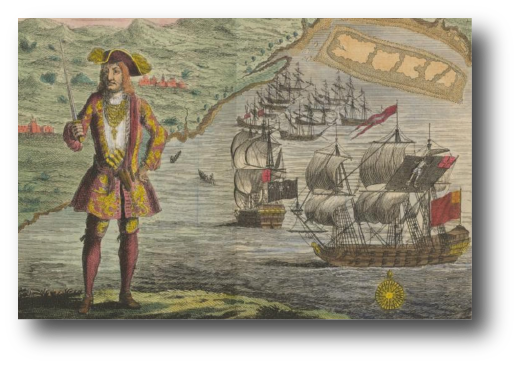
A bewildering array of terms has evolved to characterize and differentiate individuals and groups who perpetrate attacks on sea-going vessels. Corsairs carried ‘letters of marque’, authorizing them to capture vessels belonging to hostile nations which served as legal protection; they are also known as privateers. Many ex-privateers were tempted to plunder ships without authorization. Such men, who sailed with no commissions or legal protections, were known as pirates. Of course the distinction between authorized privateers and outlaw pirates, often depended on one’s perspective – and how successful they were. The distinguished Francis Drake was considered a pirate by the Spanish but feted by Elizabeth I of England who had been handsomely rewarded by Drake’s efforts. Henry Morgan’s daring assaults on the Spanish Main, despite provoking some disquiet over the extent of pillage and murder committed, were ultimately recognised in his nomination to the Deputy Governorship of Jamaica. Similarly, Hubert Hugo, a Dutch privateer in French service, was later appointed Governor of Mauritius. Notorious pirates often started their careers as privateers, and might attempt to disguise their piracy by claiming only to capture foreign ships. Piracy became a particular problem after 1603, when 50 years of Anglo- Spanish fighting ended, and again after 1713 when the Peace of Utrecht was signed, and 40,000 Royal Navy sailors were discharged.
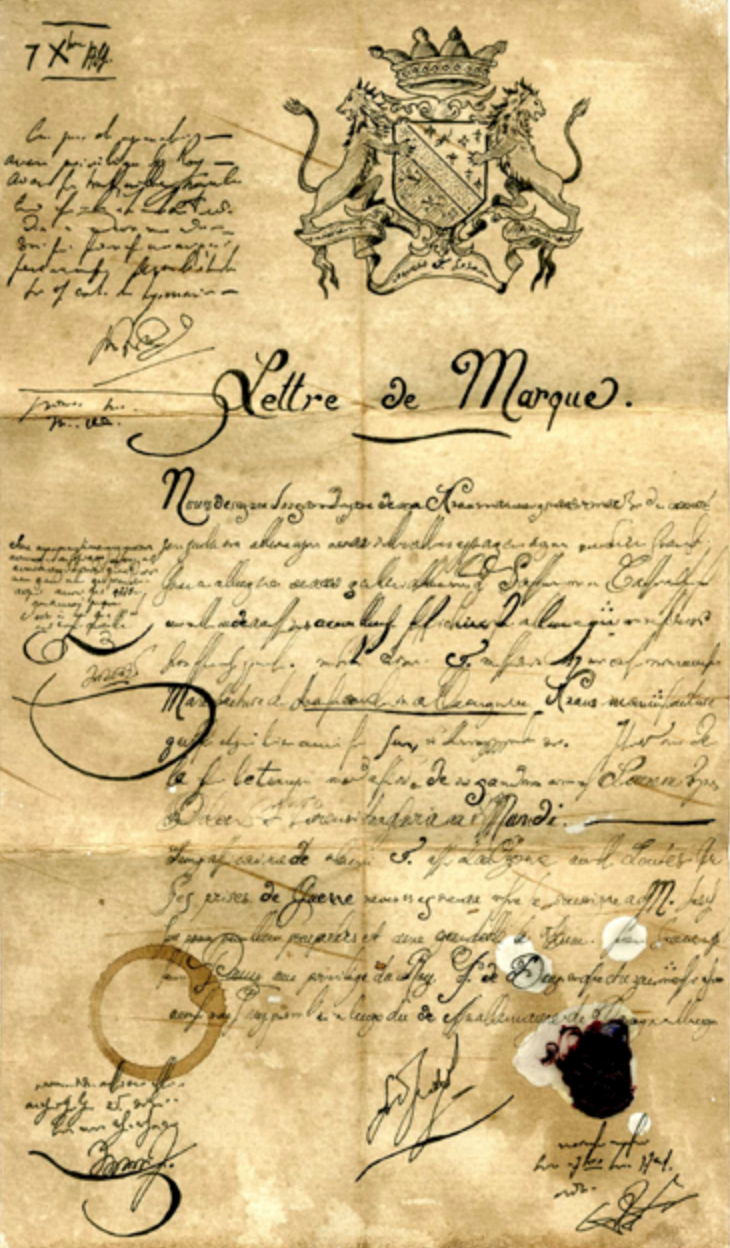
Letter of marque – Lettre de Marque
Buccaneering in the Caribbean is conventionally dated from about 1640, when bands of renegades from the recently settled British and French islands the outer Antilles established themselves in locations along Spanish trade routes where they could obtain supplies in between hijackings. A favourite haunt was the northern coast of Hispaniola. The term buccaneer originally referred to their method of smoking or ‘boucaner’ the hogs and cattle which they hunted, slaughtered, and sold to passing ships. The distinction lay in whether a man was serving his country by pillaging enemy shipping, or whether he was indiscriminately plundering and killing to satisfy his own greed. Privateers differed from pirates in that they were commissioned to attack the ships and bases of hostile nations, and, whilst effectively, in many cases, enriching themselves, were in principle supposed to hand over their plunder to the benefit of their nation and sovereign.
The fine line between privateering and piracy, when viewed from the point of view of opposing nations, could also be overstepped by men unable to resist the temptation of plundering ships and ports for which they had no commission, and even those of their own compatriots. It was not uncommon for 17th century colonial Governors to find themselves forced to hunt down privateers sent out on commissions, who had subsequently turned pirate and become a threat to their own side.
The route used by pirates who travelled from the Caribbean to the Indian Ocean and Red Sea to plunder shipping, before returning to sell goods to colonists in North America, became known as the pirate round. Its heyday was the thirty year period between 1690 and 1720.
From 1498 when the Portuguese had sailed into the Indian Ocean and found that their objects of trade – wool, olive oil, and minerals – secured few buyers, the European strategy in the region became one of dominating trade routes by force and attacking local merchant and pilgrim ships. During the 16th century, English, Dutch and French mariners joined in the orgy of plunder. These early pirates of the Indian Ocean were often men of elite backgrounds. King Charles I and other European royals frequently commissioned such voyages. By the 1690s, many of the most notorious of the Caribbean pirates had begun to take advantage of the wealthy Mogul and Arab vessels trading between India and the Red Sea and to shift their island bases from the West Indies to Madagascar and the Comoros Islands. This switch from the Caribbean to the Indian Ocean brought the North American colonies into the ‘pirate round’ and from the 1690s booty poured in to New York and New England from the Red Sea plunderers. This was an age in which India was rich and colonial America was poor. The new wealth attained by the pirates and their descendants was transformative and played an important part in shaping the world we know today.
Further information can be found under this link: Pirates of Mauritius
All articles Backgrounds
WHO WERE THE PIRATES? from Marina Carter
Who were these wild lads, some of whom decided to spread fear and terror on the world’s oceans at a very young age?
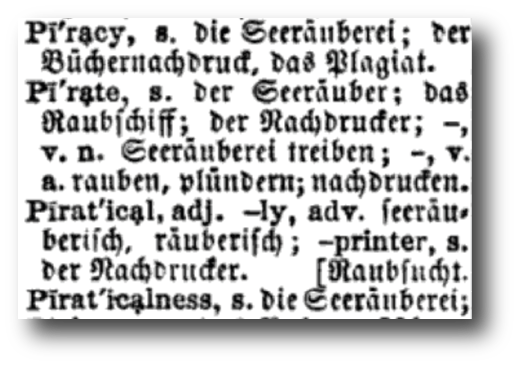
WHAT DOES THE WORD “PIRATE” MEAN? from Marina Carter
Corsair, pirate or privateer. What are the differences between these terms? We clarify.
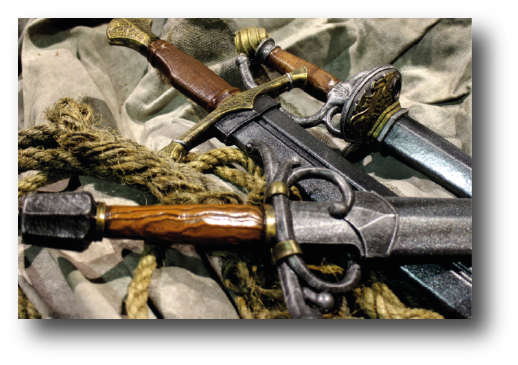
THE LOOK OF PIRATES by Marina Carter
Our image of pirates is often shaped by romanticized books and films. But what did they really look like?

