
THE PIGPEN CIPHER
It looks like a mixture of secret language and children’s scribbling – and that’s exactly what makes it so fascinating: the pigpen cipher, also known as Freemason script. The first precursors of this graphic cipher appeared as early as the Middle Ages, and later Knights Templar, alchemists and Freemasons used their very own symbolic language to encode messages. The code became really well known in the 18th century when Freemasons used it to keep their rituals and notes secret. Particularly exciting: the famous cryptogram of the pirate La Buse was also written using a variant of this code – and treasure hunters are still puzzling over its message to this day. What is behind this strange symbolic writing and why has it persisted so stubbornly in the world of secrets for centuries?
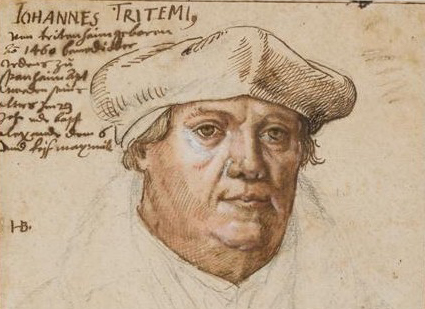
Johannes Trithemius
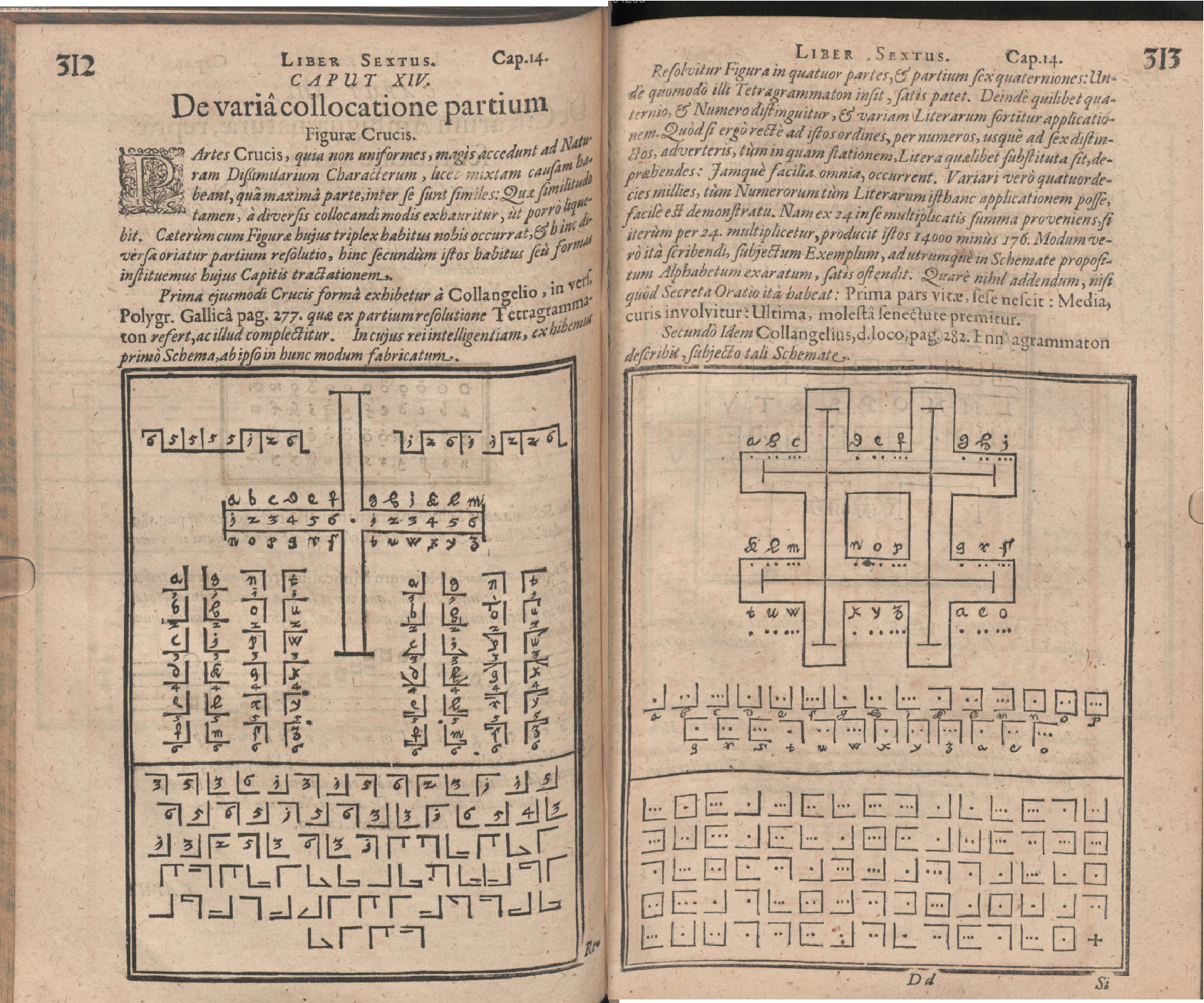
The so-called pigpen cipher, also known as Freemason script, is a graphic substitution code in which letters are replaced by simple geometric symbols. It is often claimed that the origins of this code date back to antiquity or the Middle Ages. There are references to comparable alphabet systems in the Jewish Kabbalah, in particular the so-called “Kabbalah of the Nine Chambers”, in which the 27 letters of the Hebrew alphabet are written in three superimposed fields; above each letter is the numerical value and one, two or three dots, which indicate the position of the letters in the individual chambers. It is assumed that the Order of the Knights Templar used a preliminary form of the Pigpen cipher during the Crusades in the 12th and 13th centuries. However, such a system was first clearly documented by Johannes Trithemius (1462-1516). He was abbot of the Benedictine abbey of Sponheim and, from 1506, of the Schottenkloster monastery in Würzburg, an important and versatile scholar and humanist. Trithemius wrote over 90 theological, historical and bibliographical works and the first printed book on the subject of cryptography, Polygraphia. He completed the handwritten six-volume work, written in Latin, in 1508 and it was printed posthumously in 1518. In 1624, August II, Duke of Brunswick (1579-1666) published the 500-page work Cryptomenytices et cryptographiae libri IX under the pseudonym Gustav Selenus, which was considered the standard work on cryptology and cryptography at the time and was closely based on the unpublished work Steganographia (1499/1500) and its Polygraphia by the theologian Johannes Trithemius. The following illustrations by Selenus show Trithemius’ Tetragrammaton and Enn[e]agrammaton (from the Greek tetra and ennea = 9), which were later developed into the Masonic script.
In Heinrich Cornelius Agrippa von Nettesheim ‘s (1486-1535) De occulta philosophia (1533), a cipher derived from the Kabbalah, there is a grid of nine, reminiscent of the “Kabbalah of the Nine Chambers”. This variant originally used Hebrew letters and served mystical-symbolic purposes rather than encrypted communication. In the 17th century, similar occult alphabets appeared among Rosicrucians and in grimoires such as the “Clavicula Salomonis”, which indicates that the idea of a geometric secret alphabet was already circulating long before the 18th century.
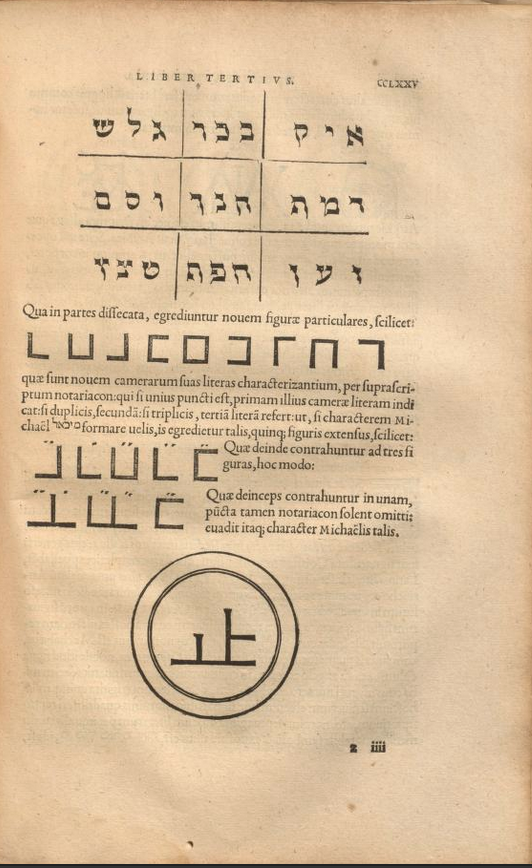
Nine Chambers with Agrippa
Distribution in the 18th century and use in Masonic circles
“At the beginning of the 18th century, the pigpen cipher was primarily known and spread by the Freemasons. Freemasonry, which institutionalized itself from 1717 with the founding of the Grand Lodge of London, adopted such geometric ciphers early on for confidential communication. There is evidence of Masonic testimonies with Pigpen ciphers as early as 1730: inscriptions in Pigpen code can be found on some Masonic gravestones of the time – for example on one of the earliest stones in Trinity Church Cemetery in New York, which bears the inscription ‘Remember death’ (Memento mori) in this cipher. Variants of the Pigpen cipher were used so frequently by Rosicrucians and Freemasons in the course of the 18th century that the code is still called ‘Freemason’s cipher’ in English today. According to some sources, the Freemasons are even said to have invented this code themselves. In any case, there is historical evidence that from the 1740s at the latest, many lodges kept their minutes, rites and correspondence in Pigpen or similar ciphers. Around 1730, the Pigpen cipher was therefore not common knowledge, but was certainly in circulation within secret societies such as the Freemasons.” (ChatGPT, deep research)
It is astonishing that, despite intensive research on the Internet, no images of handwritten Pigpen documents from the 18th century can be found. This suggests that the code was actually used primarily in direct communication between two lodge members and that a corresponding handwritten message (in letter form) was destroyed after being read.
The way Freemasonry works
Most illustrations of the pigpen cipher use the model with 4 grids, which are continuously filled with the letters of the alphabet (illustration on the right). The cryptogram, on the other hand, was encoded using only two grids (illustration on the left), in which the letters are written in pairs in the empty spaces of the grids.
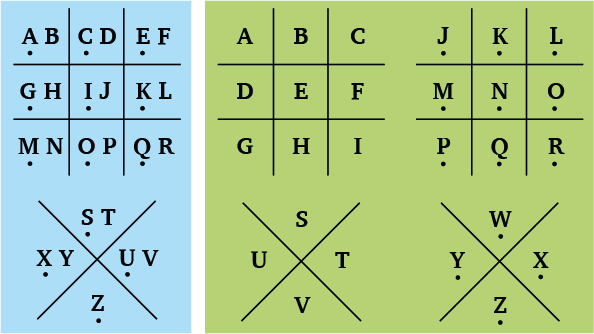
To write a letter as a pigpen character, take the lines that run around the corresponding letter. To keep the pairs of letters apart, a dot is placed in the character for the first one.
Examples (illustration on the left):

The complete alphabet
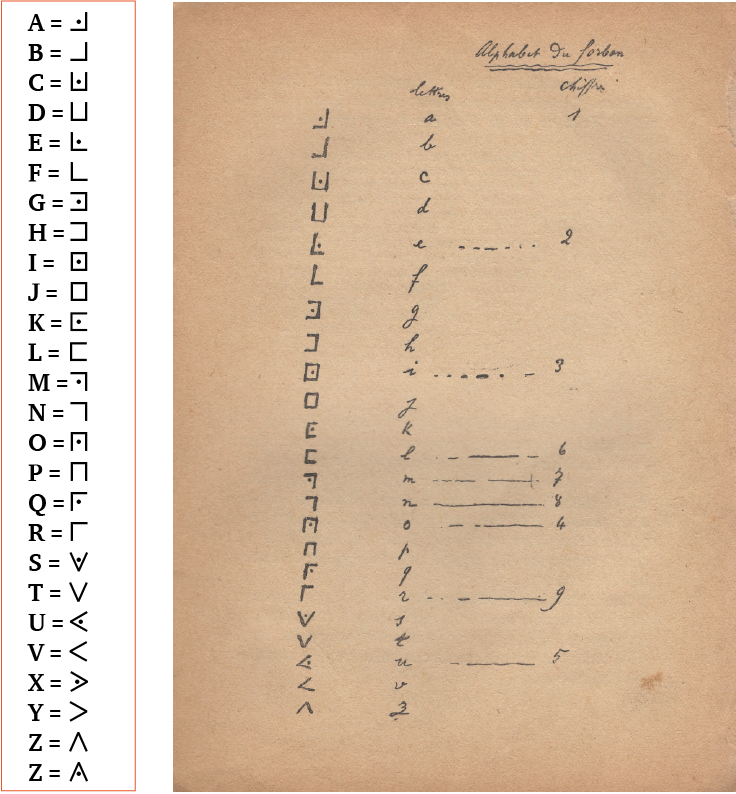
On the right is the key that de la Roncière published in the “Flibustier“. The letters W, X and Y, which do not appear in the cryptogram, are missing. X and Y would theoretically have a place in the grid on the left, but are not used in the text, while W is not included in the alphabet of the code. There are two options for Z. Both appear in the cryptogram text.
De La Roncière assigns an additional digit to 9 characters in his key:
a = 1, e = 2, i = 3, o = 4, u = 5, l = 6, m = 7, n = 8, r = 9
How he arrives at this assignment remains a mystery. The transcription of the cryptogram does completely without digits.
Sources mentioned:
– Trithemius, Johannes: Polygraphiae libri sex, Reichenau: Johannes Haselberg, July 1518, available online
– Selenus, Gustavus (pseudonym for Duke August von Braunschweig-Lüneburg): Cryptomenytices et cryptographiae libri IX, Lüneburg: Johann und Heinrich Stern, 1624. available online
– Agrippa von Nettesheim, Heinrich Cornelius: De occulta philosophia libri tres, Cologne: Soter, 1533. available online
– Anonymous: Clavicula Salomonis (also known as The Key of Solomon), a grimoire from the 14th or 15th century, first published by Samuel Liddell MacGregor Mathers, London: 1889.
All articles Cryptogram
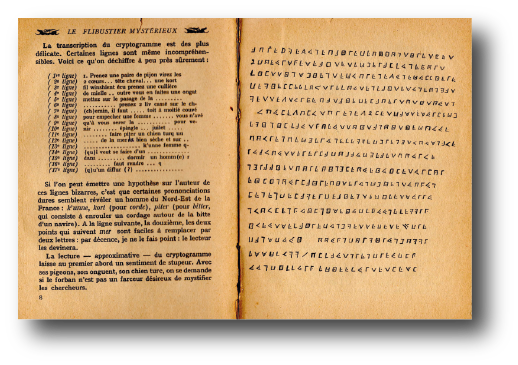
The cipher that has been sprouting the fantasies of many people in all its aspects for 90 years.
All articles La Buse

The life and work of the most famous French pirate of the 18th century.
All articles Backgrounds
Stories and history about the “Golden Era of Piracy”, La Buse and the cryptogram.

